When in Doubt Add Bacon
Let’s be honest: sarcasm sells—especially when it’s stitched cleanly, sized thoughtfully, and lands with that warm, knowing chuckle from someone who *gets it*. As a designer who’s digitized over 400 embroidery files and reviewed thousands more for craft businesses, I tested When in Doubt Add Bacon on a custom embroidered canvas tote bag destined for a local farmers’ market booth—and what unfolded wasn’t just cute execution. It was a quiet reminder of how tone, texture, and technical execution converge in real-world embroidery.
A First Impression That Sticks (Before the Needle Does)
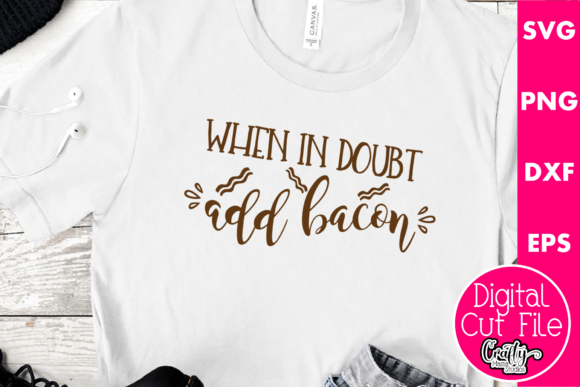
Opening When in Doubt Add Bacon, you’re met with clean lines, intentional spacing, and a visual rhythm that feels conversational—not cluttered. The phrase is set in a friendly, slightly rounded sans-serif, with “Bacon” given subtle weight and lift, like it’s winking at you. There’s no ornate border, no distracting icons, no unnecessary flourishes—just confident typography with breathing room. That simplicity is its strength. It reads instantly at 3.5 inches wide on a tote, holds up at 2.25 inches on a baby onesie chest, and still lands when shrunk to 1.75 inches for a pocket patch.
Where It Shines—and Where It Asks for Attention
This isn’t a design that begs for spotlight placement on a black hoodie back panel. It thrives in context: on kitchen towels where humor meets function, on aprons worn by bakers who actually *do* add bacon to everything, or on nursery pillows where parents appreciate dry wit without saccharine clichés. I stitched it onto a medium-weight cotton twill tote using standard cutaway stabilizer and 40-weight polyester thread—no hiccups. The letterforms held crisp edges; the “B” didn’t bleed, the “t” in “Doubt” didn’t collapse, and the negative space between letters stayed open and legible.
But here’s where experience kicks in: When in Doubt Add Bacon doesn’t translate well to ultra-stretchy fabrics like ribbed cotton jersey without significant underlay adjustment—and even then, test first. On dark fabric, contrast matters: a warm tan or oatmeal thread lifts the text beautifully, while charcoal can mute the playfulness. And avoid placing it on curved surfaces like structured caps unless you’ve confirmed the file includes proper condensation or has been pre-digitized for cap hoops. The original SVG description mentions Cricut compatibility and Titan 3 cut testing—but remember: cutting performance ≠ embroidery readiness. Digitizing for stitch logic, tension balance, and fabric interaction is a separate discipline.
Real-World Fit Across Craft Business Needs
- For Etsy sellers: This works as both a standalone machine embroidery design and a smart pairing with a “Breakfast Lover” or “Brunch Squad” collection. Customers love cohesive, personality-driven bundles—and When in Doubt Add Bacon adds instant voice to a digital embroidery file shop.
- For small shop owners: Stitch it onto tea towels sold alongside maple syrup or locally smoked bacon—suddenly it’s not just text, it’s storytelling with shelf appeal.
- For personalized gifts: Pair it with a monogram or birth year on a baby blanket? Yes—but only if the file allows easy resizing without distortion. Always inspect the vector paths before scaling down past 2 inches.
- For commercial embroidery shops: Its moderate stitch density makes it efficient for batch runs on sweatshirts or unisex tees. No dense fill stitches bogging down production—just clean satin and running stitch transitions.
What It Says About Your Brand—Without Saying a Word
Using When in Doubt Add Bacon signals approachability, confidence, and a refusal to take craft too seriously—which resonates deeply with today’s handmade buyer. It elevates a plain tote from “generic gift” to “thoughtful, memorable.” But that only holds if execution matches intent. A poorly stabilized run on thin linen will make the letters look fuzzy and undermine trust. A mismatched thread color on a cream sweater can read as careless—not cheeky. This design earns its charm through precision, not just concept.
Practical Designer Notes Before You Stitch
- Test When in Doubt Add Bacon on scrap fabric matching your final project’s weight and weave—especially if using textured weaves like duck cloth or terry.
- Check stitch density in tight curves (like the inner counter of the “a” in “Bacon”)—overly dense areas trap thread and cause puckering on lightweight cotton.
- Confirm hoop size compatibility: does the design fit comfortably within your most-used hoop, or will you need to split it for larger garments?
- Review licensing: the listing notes these are SVG files cut-tested on a Titan 3, but says nothing about commercial use rights for finished embroidered products. If you plan to sell physical items, verify terms directly with the creator.
- Use a printable mockup to preview how it reads on light vs. dark backgrounds—some sarcasm gets lost in low-contrast pairings.
- Try stitching it in black thread on natural canvas and white thread on navy denim. Compare clarity, pop, and perceived value.
Final Thought: Humor Has Texture Too
Great embroidery design doesn’t just communicate—it resonates through touch, wear, and repetition. When in Doubt Add Bacon succeeds because it balances wit with wearability. It’s not trying to be everything. It’s a focused, functional, friendly piece of design assets—ideal for craft business owners who understand that sometimes, the best branding isn’t loud. It’s just perfectly, deliciously, bacon-flavored.
If you’re sourcing graphics for your next round of custom apparel, embroidered patches, or boutique merchandise, treat When in Doubt Add Bacon as a reliable supporting player—not a headline act. Use it where warmth and authenticity matter more than flash. And always, always stitch a test first. Because in embroidery—as in life—when in doubt? Add bacon. Then check your stabilizer.